Mushroom Guides
What Are Multi-Mushroom Supplements? A Practical Consumer Guide
A multi-mushroom supplement combines extracts or powders from several fungi — commonly reishi, lion’s mane, cordyceps, shiitake and others — in a single capsule or scoop. Compared with a single-mushroom product it offers variety in one dose, but it usually discloses less about how much of each mushroom you receive. Before buying, check the form of each mushroom, whether amounts are listed, and what the label actually claims.
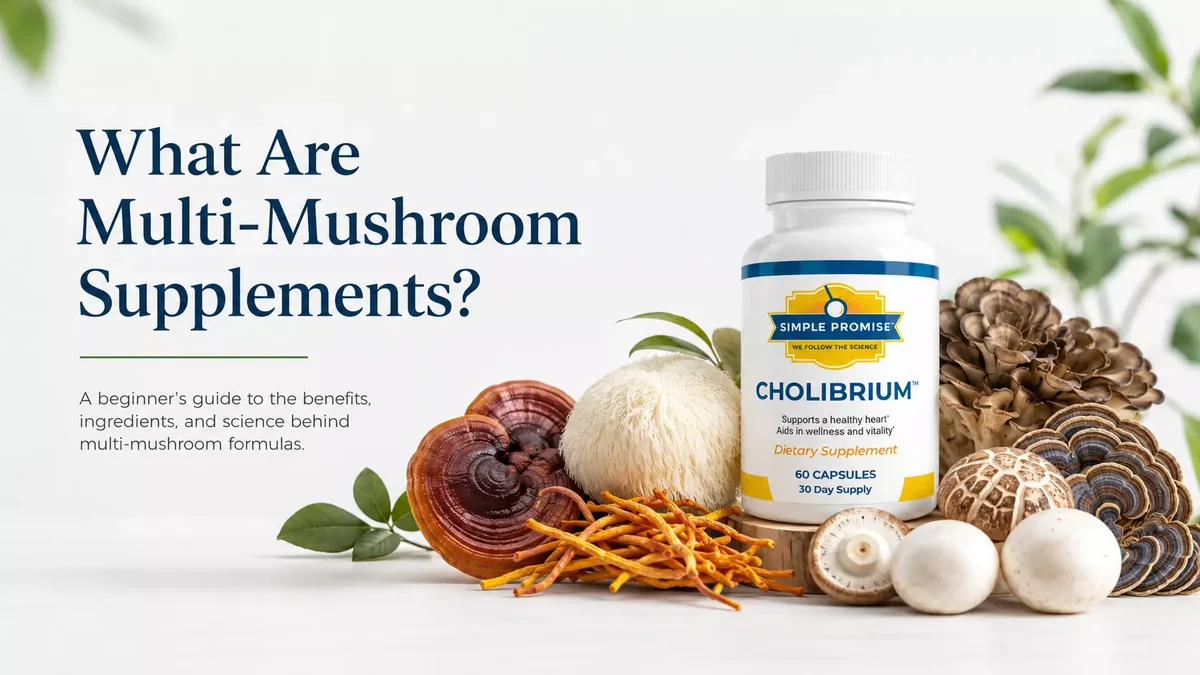
What a multi-mushroom supplement is
A multi-mushroom supplement is a single product that packs several mushroom species together — often four, seven, or ten at a time. Manufacturers usually pick fungi with a long history in traditional East Asian medicine, such as reishi, cordyceps, lion’s mane, shiitake, maitake, turkey tail and chaga. The pitch is convenience and breadth: one capsule instead of a shelf of separate bottles.
These products sit in the “functional” or “adaptogenic” corner of the supplement aisle. It helps to keep two categories separate in your mind. Culinary mushrooms are food. Concentrated extracts sold in capsules are dietary supplements, which the U.S. Food and Drug Administration regulates as a category of food rather than as drugs. That distinction matters, because the FDA does not review supplements for effectiveness before they go on sale [1].
Heart-focused blends are a growing niche. They tend to lean on the idea that certain mushrooms contain beta-glucans — a type of soluble fiber — and other compounds that have been studied in relation to cholesterol, blood sugar and antioxidant activity. Whether a finished capsule delivers enough of those compounds to matter is a separate question, and one the label rarely answers directly.
Extract or powder, fruiting body or mycelium
Two details do more than anything else to separate a considered product from a filler-heavy one: the form of the mushroom and the part of the mushroom used.
Fruiting body versus mycelium
The fruiting body is the recognizable mushroom — cap and stem. The mycelium is the thread-like network the fungus grows from, and in commercial production it is often grown on grain and dried together with that grain. That can leave a large share of starch in the finished powder. Neither form is automatically useless, but a label that clearly states “fruiting body” is usually giving you more of the compounds people are actually seeking.
Extract ratios and what “10:1” means
An extract concentrates the mushroom using hot water, alcohol, or both. A ratio such as 10:1 means ten kilograms of raw mushroom were used to make one kilogram of extract. Higher ratios sound impressive, but the number alone tells you nothing about the compound that matters. A more useful figure is a stated beta-glucan percentage or milligram amount, because that is measurable. If a label touts a big ratio yet hides the actual quantities, treat the ratio as marketing rather than proof [3].
Serving size, proprietary blends and label transparency
Turn the bottle around and read the Supplement Facts panel. Start with serving size — is it one capsule or three? A price that looks low per bottle can be high per day if the serving is large. Then look at how the ingredients are listed.
Many blends use a “proprietary blend,” which lists the combined weight of all the mushrooms without saying how much of each is present. This is legal and common, and it isn’t proof of a bad product. But it does hide the one thing you need to judge value: whether a given mushroom is present in a meaningful dose or just a sprinkle for the label. When amounts are undisclosed, you also can’t line the product up against the doses used in research, so any comparison to a study becomes guesswork.
A framework for evaluating a multi-mushroom product
You don’t need a science degree to size up a blend. A short, repeatable checklist does most of the work. Run any product — including any heart-marketed blend — through these questions before you spend anything.
| What to check | A more transparent product | A weaker sign |
|---|---|---|
| Part used | States “fruiting body” for each species | Only says “mushroom” or “mycelium on grain” |
| Amounts | Lists milligrams per species, or a measured beta-glucan amount | Single proprietary-blend weight only |
| Extract detail | Names the extraction method and a beta-glucan percentage | Shows a big ratio (e.g. 20:1) and nothing else |
| Claims | Uses “may support” language and cites research honestly | Promises to lower cholesterol or “detox” the body |
| Testing | Mentions third-party testing or a certificate of analysis | No testing information anywhere |
| Contact | Clear company name, address and refund policy | No way to reach a real business |
Cholibrium is a useful case study for this framework because it sits squarely in the heart-marketed, ten-species end of the category. Its maker names all ten mushrooms but, like many blends, does not publish the individual amounts. If you want to see how one such product presents itself, this overview of the Cholibrium formula on the manufacturer’s website lays out its own description — read it as the company’s account, then apply the checklist above yourself. For a deeper walk through any Supplement Facts panel, our guide on reading a mushroom supplement label goes line by line.
What the evidence does and doesn’t show
Here is the honest state of play. Beta-glucan, the soluble fiber found in mushrooms, has genuine research behind it for modest cholesterol lowering — but the strongest human evidence comes from oat and barley beta-glucan, not from mushrooms, and mushrooms generally contain far less of it [3]. When researchers have looked specifically at a medicinal mushroom and cardiovascular risk factors, results have often been underwhelming. A Cochrane systematic review of reishi (Ganoderma lucidum), for instance, found the available trials did not show a meaningful benefit for cholesterol, blood pressure or blood sugar Systematic review [2].
Two limitations deserve emphasis. First, much mushroom research is laboratory or animal work Lab Animal, which is a starting point, not proof of a human effect. Second, and most important for blends: evidence about one isolated ingredient cannot automatically establish what a finished, multi-ingredient product does. A capsule containing ten mushrooms in undisclosed amounts has not been shown to work simply because one of those mushrooms looked promising in a dish or a petri dish. Confirming how a complete formula performs would require studying that specific formula in people.
Findings about a single mushroom do not prove that a multi-mushroom product produces the same result. Product-specific human research would be needed to know how a finished combination performs.
What to do next
If you’re curious about multi-mushroom supplements, a measured approach beats an impulse buy. Read the label with the checklist above, and be skeptical of any product that promises a specific health outcome. If your interest is heart health specifically, remember that a supplement is not a substitute for the things with strong evidence — diet, physical activity, not smoking, and, where a clinician recommends it, medication.
Above all, if you take prescription medicine, are pregnant or breastfeeding, or have a diagnosed condition, talk with a pharmacist or doctor before adding any mushroom supplement. Some fungi can interact with medications, a topic we cover in our guide to side effects and interactions. To see how the research stacks up across species, the evidence review is the natural next read.