Mushroom Guides
Cholibrium Ingredients Explained: What the Label Tells Consumers
Cholibrium is marketed as a ten-mushroom formula containing reishi, lion’s mane, cordyceps, shiitake, maitake, turkey tail, chaga, black fungus, white button and royal agaricus. The label names the species but, per the manufacturer, does not disclose how much of each you get. Below, each mushroom’s stated role is placed next to what research actually shows, so you can tell claims from evidence.
The ingredient list and blend details here were read from the manufacturer’s website on that date [1]. Prices, availability, package details and label wording can change. Confirm current information on the product website before purchasing.
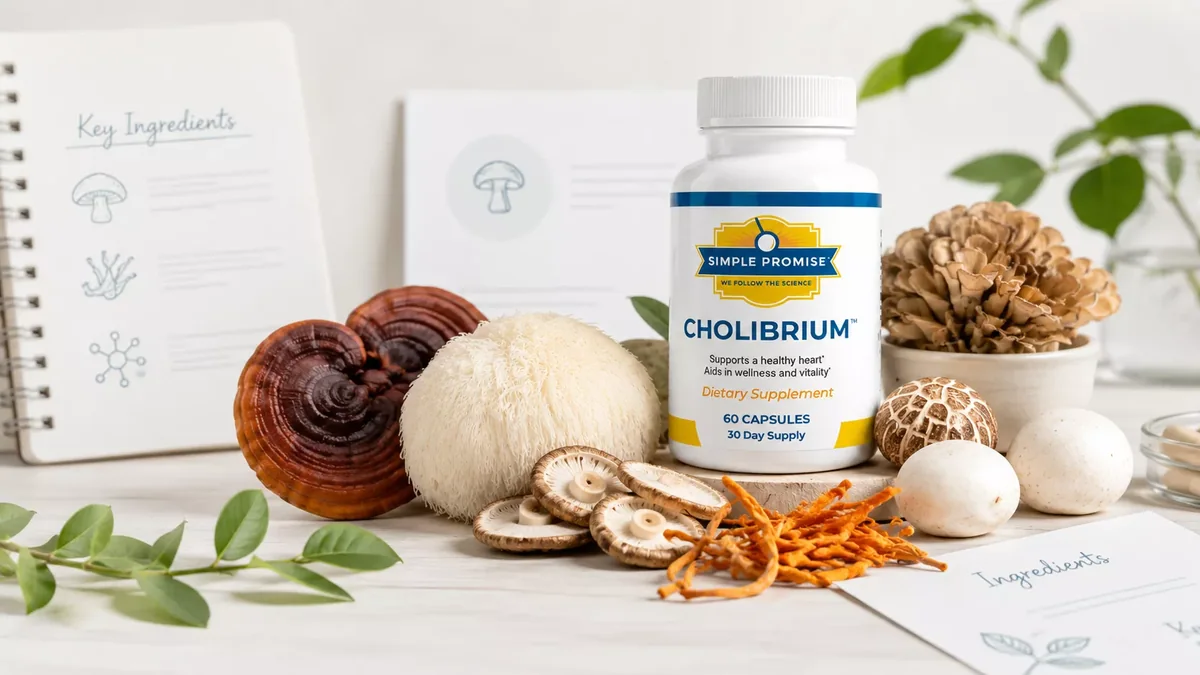
What the Cholibrium label lists
According to us-cholibrium.com, Cholibrium combines ten mushroom species in a single formula aimed at the heart-health market [1]. The manufacturer names each mushroom and pairs it with a short description of why it was included — lipid support, circulation, antioxidant defense, and so on. What the label does not provide, by the company’s own account, is the quantity of each mushroom, because the product is sold as a proprietary blend.
That combination — named species, hidden amounts — is the single most important thing to understand about this label, and about many blends like it. Naming ten mushrooms is a transparency point in its favor. Withholding the amounts is a transparency limit that shapes everything you can reasonably conclude.
The ten mushrooms: manufacturer’s claims versus evidence
The table below sets each mushroom’s manufacturer-stated role against a grounded summary of the research, and tags the strongest type of evidence available for the cardiovascular or metabolic angle. The middle column is the company’s reason for including the ingredient; it is not a proven effect.
| Mushroom | Manufacturer’s stated role [1] | What the research actually shows |
|---|---|---|
| Reishi (Lingzhi) | Lipid balance and HDL support | Best-studied of the group for heart markers, yet a Cochrane systematic review found the available human trials did not show a meaningful effect on cholesterol, blood pressure or blood sugar. Systematic review |
| Lion’s Mane | Triglyceride and cognitive support | Lipid effects come mainly from animal and laboratory work; human cardiovascular data are very limited. Most human interest has centered on cognition and mood, still at an early stage. Animal / lab |
| Cordyceps | Circulation and energy | Studied in the lab and in small exercise trials with mixed results; cardiovascular or ‘energy’ benefits are not established in robust human research. Small human |
| Shiitake | Eritadenine and beta-glucans | Eritadenine has lowered cholesterol in animal studies; convincing human trials at supplement doses are lacking. Culinary shiitake is a food source of beta-glucan. Animal / lab |
| Maitake | Fat metabolism support | Glucose and lipid effects appear mostly in animal and laboratory studies; human evidence is limited and preliminary. Animal / lab |
| Turkey Tail | Antioxidant defense | Most human study relates to immune support in cancer care (a compound called PSK), not cardiovascular outcomes. Antioxidant activity is largely a laboratory finding. Lab |
| Chaga | Inflammatory response | Anti-inflammatory and antioxidant effects are seen in cell and animal studies; human evidence is lacking. Chaga is high in oxalates, a kidney-safety consideration. Animal / lab |
| Black Fungus (Tree Ear) | Cholesterol and circulation | Older, small human and observational work has looked at platelet activity; evidence for cholesterol lowering in supplement form is limited and not conclusive. Observational |
| White Button | Beta-glucan base | A common edible mushroom with a relatively low beta-glucan content compared with oats; a cholesterol-lowering effect from White Button in a capsule is not well established. Lab / food |
| Royal Agaricus | Blood pressure and antioxidants | Immune and antioxidant effects are mostly from laboratory and animal research; human cardiovascular data are lacking, and rare liver-related case reports have been published. Animal / lab |
Read across the rows and a pattern emerges: the manufacturer’s descriptions are consistently more confident than the published human evidence. Reishi is the clearest illustration. It is the most-studied mushroom here for heart markers, yet a Cochrane systematic review — the most rigorous kind of evidence summary — concluded that the available trials did not support a meaningful effect on cholesterol, blood pressure or blood sugar [2]. For several other species, the supporting work is largely animal or laboratory research, which cannot stand in for human results.
If you want to see the company’s own presentation of each ingredient, the manufacturer publishes a full Cholibrium ingredient guide on its website. It is worth reading as the manufacturer’s account, kept separate from the independent evidence summarized above. For the wider research picture across these species, our medicinal mushrooms and heart health review goes further.
Why undisclosed amounts matter
Doses matter in nutrition and pharmacology. The beta-glucan studies that show a modest cholesterol benefit generally used multiple grams per day, mostly from oats [3]. When a capsule blends ten mushrooms into one undisclosed total, there is no way to know whether any single one reaches a dose that research has looked at, or whether it is present in a token amount.
This is why we’re careful not to translate ingredient research into product promises. Even where a mushroom has interesting data behind it, a proprietary blend hides the number that would let you connect that data to the capsule in your hand. It also makes honest price-per-active comparisons impossible, which is worth remembering when a blend is sold at a premium.
Findings concerning individual ingredients cannot automatically establish the effectiveness of the complete Cholibrium formula. Product-specific human research would be needed to determine how the finished combination performs, and we did not find such a trial.
Manufacturing and quality claims
The manufacturer describes the extracts as non-GMO and made in a cGMP-compliant U.S. facility, and says the formula suits vegan, keto and paleo diets [1]. These are quality-control and dietary descriptors. “cGMP” refers to current Good Manufacturing Practice — standards for how a product is made, labeled and stored so that what’s in the bottle matches the label. It is genuinely useful, but it is easy to misread.
cGMP compliance does not mean the FDA has tested the product or confirmed that it works. Under U.S. law the FDA does not approve dietary supplements for safety or effectiveness before they are marketed; responsibility for substantiating claims sits with the company [4]. So a cGMP claim speaks to consistency, not to whether the formula lowers anything.
Limitations of this information
A few honest caveats. First, product details can change; treat the July 11, 2026 date as a snapshot. Second, because amounts are undisclosed, our evidence notes describe the mushrooms in general, not the specific doses in this product. Third, absence of a published trial of the finished formula is not the same as proof that it does nothing — it simply means the product-level question is unanswered. We report what can be verified and flag what cannot.
What to do next
Use the ingredient list as a starting point for questions, not as a set of guarantees. If a specific mushroom interests you, read the underlying research rather than the marketing line. If your goal is cardiovascular health, bring the label to a pharmacist or doctor who can weigh it against your medications and history — especially relevant here given ingredients like chaga (oxalates) and species that may affect bleeding.
From here, two reads help you go deeper: our line-by-line guide to reading a mushroom supplement label, and the side effects and interactions article for the safety side.